

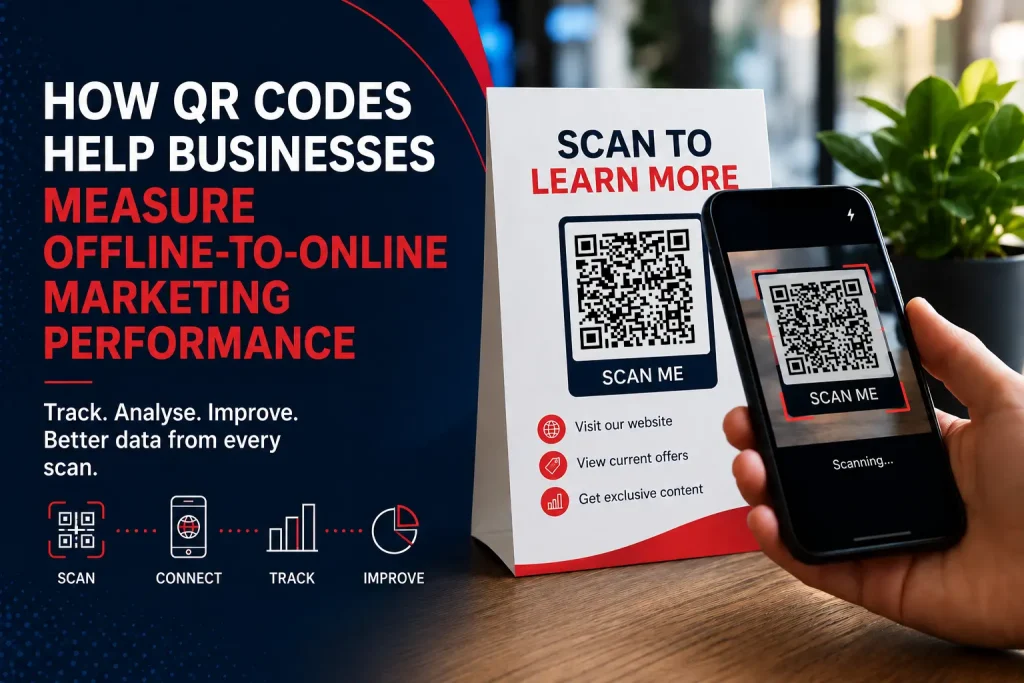
How QR Codes Help Businesses Measure Offline-to-Online Marketing Performance
For many businesses, marketing no longer sits neatly in either the “offline” or “online” category. A customer might see a flyer, scan a QR code, visit a landing page, watch a video, compare a product, and come back later through Google or social media before making an enquiry.
The challenge is knowing which offline touchpoints are actually creating digital engagement.
That is where QR codes can be extremely useful. When set up properly, they help businesses connect physical marketing materials to measurable online actions. Instead of guessing whether a brochure, poster, event sign, product label or print campaign worked, businesses can use QR codes to see how people interacted with the campaign.
The problem with traditional offline marketing
Offline marketing is still valuable. Business cards, flyers, signage, packaging, event banners, menus, table cards and printed brochures can all influence buying decisions.
The problem is that offline marketing has traditionally been hard to measure.
A business might print 5,000 flyers and receive more website enquiries the following week, but it can be difficult to know whether those enquiries came from the flyer, Google, word of mouth, social media or a returning customer.
This makes it harder to answer questions such as:
-
- Which print campaign generated the most interest?
- Did people engage with the offer?
- Which location performed best?
- Did the event signage lead to real website visits?
- Are customers scanning but not converting?
- Should the campaign be repeated?
QR codes help close that measurement gap.
QR codes create a bridge between physical and digital marketing
A QR code gives customers a simple action to take from a physical item. Instead of typing a long website address, they can scan and go straight to a relevant digital destination.
That destination might be:
-
- A product page
- A booking form
- A quote request page
- A video
- A menu
- A Google review link
- A downloadable PDF
- A competition landing page
- A location-specific offer
- A campaign-specific landing page
This means a printed item can become a measurable entry point into your digital marketing funnel.
For example, a real estate agency could place different QR codes on property brochures, window cards and auction flyers. Each code could point to a dedicated property page or enquiry form. Over time, the agency can see which materials generate the most scans and which campaigns lead to actual enquiries.
Why dynamic QR codes are better for campaign tracking
Static QR codes point to one fixed destination. Once printed, the destination cannot usually be changed. That can be fine for simple use cases, but it is limiting for marketing campaigns.
Dynamic QR codes are more flexible because the destination can be updated after the code has been created. This is useful when a campaign changes, a landing page moves, or a business wants to test different offers without reprinting everything.
Dynamic QR codes can also provide useful scan data, depending on the platform being used. This may include information such as:
-
- Number of scans
- Time and date of scans
- Device type
- General scan location
- Campaign performance by QR code
- Which printed asset generated activity
This gives businesses much better visibility over how offline marketing is performing.
Practical examples of offline-to-online QR code tracking
QR codes can be used across many industries. The key is to create a clear reason for the customer to scan.
1. Flyers and brochures
A flyer can include a QR code that sends people to a dedicated campaign landing page. This allows the business to measure whether the flyer generated traffic, not just whether enquiries increased generally.
For example, a local service business could use one QR code for a letterbox flyer campaign and another for a trade show brochure. If the trade show code gets more scans and better enquiries, the business has a clearer idea of which activity was more valuable.
2. Event signage
Events are full of offline marketing opportunities. Posters, banners, table cards, name badges and handouts can all include QR codes.
A QR code might link to a sign-up form, product demo, downloadable guide, competition entry or booking page. This helps turn event attention into measurable digital engagement.
3. Product packaging
Packaging is a strong QR code use case because the customer already has the product in their hand. A QR code can link to instructions, warranty registration, recipes, reorder pages, video tutorials or customer support.
This creates a post-purchase digital journey that can be measured and improved.
4. Print ads
Magazine, newspaper and local directory ads often suffer from weak tracking. A QR code can help identify whether a specific print ad created digital engagement.
Instead of sending everyone to the homepage, the QR code should ideally point to a campaign-specific page. This makes reporting cleaner and improves the customer journey.
5. Storefronts and physical locations
A QR code on a shop window, counter sign or reception desk can link to opening hours, bookings, reviews, loyalty programs or current offers.
Different locations can use different QR codes so the business can compare engagement by store, suburb or region.
QR codes and broader search visibility
QR codes are not a replacement for SEO, content marketing or brand visibility work. However, they can support those efforts by sending real users to useful pages, videos, resources and offers.
As search continues to change, businesses are also paying more attention to how visible their brand is across AI-driven search experiences. Tools such as Fokal, an AI SEO visibility tool, can help businesses understand how they are appearing across emerging AI search and GEO environments.
QR codes can play a supporting role in this broader visibility strategy by making it easier for offline audiences to engage with the right digital content.
How to make QR code campaign tracking more useful
To get better data from QR code campaigns, businesses should avoid sending every scan to the homepage.
Instead, use a specific destination that matches the campaign. For example:
-
- A flyer should link to a relevant offer page
- A product label should link to product-specific information
- An event banner should link to an event landing page
- A review card should link directly to the review platform
- A brochure should link to a related service or product page
It is also helpful to name and organise QR codes clearly. For example:
-
Melbourne Expo 2026 BannerAutumn Flyer CampaignProduct Packaging InsertReception Desk Review CardCafe Table Menu QR
This makes reporting easier later.
Common mistakes to avoid
QR codes are simple to use, but small mistakes can reduce their effectiveness.
One common mistake is using a QR code without a clear call to action. A code by itself is not always enough. Tell people what they will get when they scan it.
For example:
-
- “Scan to view the menu”
- “Scan to book a consultation”
- “Scan to watch the demo”
- “Scan to claim the offer”
- “Scan to download the guide”
Another mistake is linking to a page that is not mobile-friendly. Most QR code scans happen on mobile devices, so the destination page should load quickly, be easy to read, and have a clear next step.
Businesses should also test the QR code before printing. A simple typo, broken redirect or poorly sized code can ruin an otherwise good campaign.
Final thoughts
QR codes are one of the easiest ways to connect offline marketing with online measurement.
They help businesses turn physical materials into trackable digital entry points. Flyers, brochures, packaging, event signage, shopfront displays and print ads can all become measurable parts of a marketing funnel.
The real value comes from using QR codes strategically. A good QR code campaign should have a clear purpose, a relevant destination, a strong call to action and a way to measure engagement.
For Australian businesses investing in both offline and online marketing, QR codes can provide a practical way to understand what is working, improve campaign performance and create a smoother path from first impression to online action.
Need help creating trackable QR codes for your next print or offline campaign? Explore our QR code generator or contact QR Media for help setting up your campaign.